
Our March 2026 Improvisation Lab (thanks to The Vortex), for people who identify as transfem, transmasc, nonbinary, and any kind of women, included exploration of different spectra by different improvisers at the same time… each person chose a specific linear or binary spectrum and tried to improvise just in that plane, while listening to and responding to the others… it was very stimulating!
6 January 2026: ONe_Orchestra New members got together at The Vortex for our January improvisation lab, very fruitful. We began with voices, all sustaining a single common pitch, and then building an improvisation from it that changed in other parameters but not in pitch. We did vocal variations on John Stevens’ click piece, and then, without intending it, were drawn into fast exchanges of very clipped words. We worked on concertation and intercalation, and on shadowing and counter-shadowing… an excellent afternoon on the one snowy day of the winter so far.
21 December 2015: Many members of ONe_Orchestra New were part of organising and playing in a 12-hour unceasing free improvisation at The Horse Hospital. An ever-shifting sequence of extraordinarily varied, inventive, committed and inspiring improvisation.
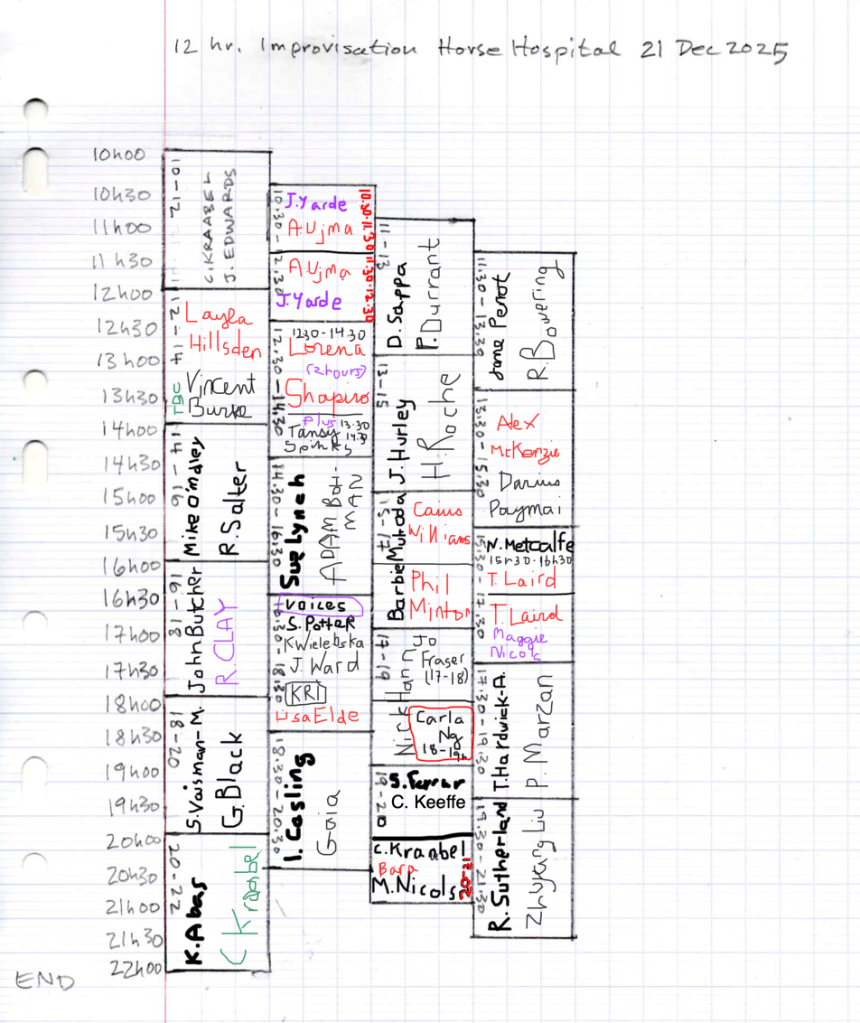
15 December 2025: ONe_Orchestra New improvisation Lab, The Horse Hospital.
At our December improvisation lab we did a whole series of one-minute improvisations, to contrast with the very long improvisations we’ve been doing – a very different discipline, thrilling and frustrating… We also thought about destabilising our relationship with our instruments/voices, in order to defamiliarise ourselves with our sounds and habits, challenge ourselves to find new mistakes… in this instance by handling or using our tools and bodies in different, awkward or “incorrect” ways. We played in shifting pairs and tried selective listening.

Teresa Hackel, photo by C. Kraabel.
14 October 2025: In a modest tribute to ONe_Orchestra New’s work in much longer formats than the standard “gig”, ONe_Orchestra New improvise for two hours at Cafe Oto!
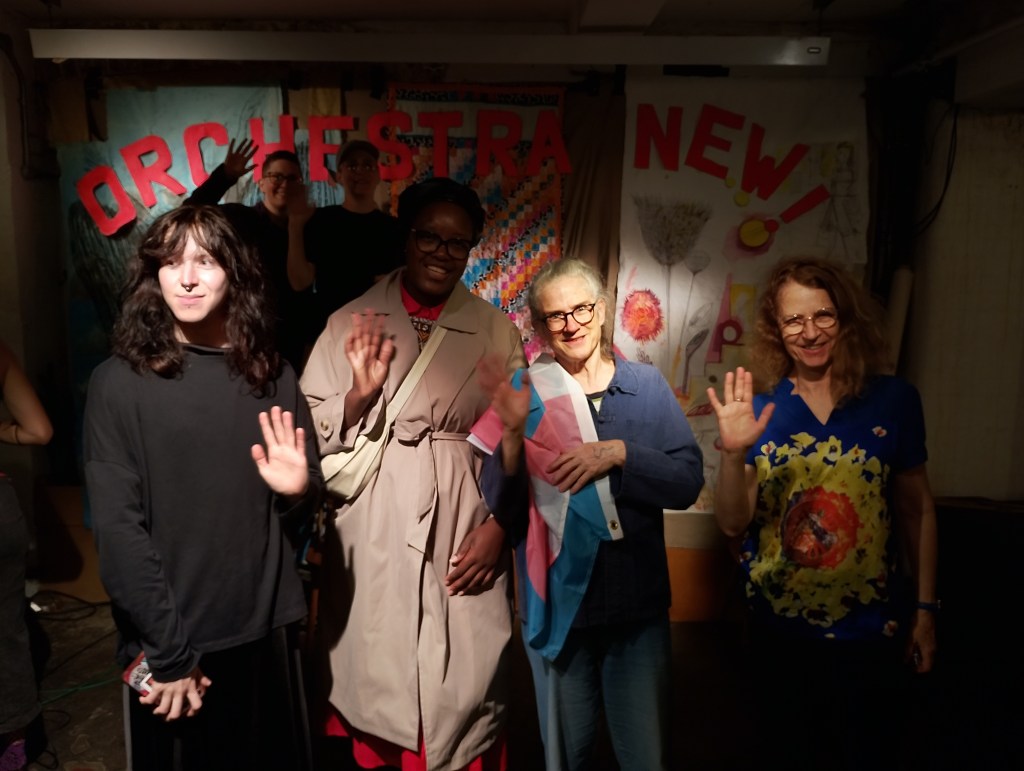
Cafe Oto, 14 September 2025. Backdrops by C. Kraabel, B. Mukoda, S. Lynch, C. Roberts
27 June 2022: ONe_Orchestra New improvisation lab, The Vortex, Dalston
The ONe_Orchestra New June improvisation Lab at The Vortex was lovely – we worked some more on non-binary improvising, establishing a few binaries and exploring them first, concentrating on their vast inner ranges, rather than the extremes….then we tried to combine sliding at different rates and in different ways along the spectra of two distinct binaries at the same time, so they intersect in myriad different ways. This was challenging, and rewarding… among other discoveries, we found that each binary opened out into a multitude of different regions, lateral, perpendicular, or seemingly completely novel… (As we might have expected!) Thanks to the lovely people at The Vortex for the welcoming space.
28 May 2025: ONe_Orchestra New improvisation lab, Goldsmiths.
Three saxophones (plus ocarinas and Wurlitzer); cello, piano, violin, oboe, voice, trumpet.

Photo of Sue Lynch and Khabat Abas by C. Kraabel.
How would a non-binary improvisation sound? How would it work?
We looked at improvising along the entire spectrum of sounds and of space, not just the extremes. Worked on shifting foreground to background and vice versa, without changing the material we played, and on concertation in brief utterances. Our subsequent free improvisations were focused, transparent, detailed – everyone could be heard even when we were all playing; we tended to avoid lengthy soloistic statements.
15 April 2025: ONe_Orchestra New Improvisation Lab
We had a great morning at The Vortex on Tuesday – it felt unusual and GOOD to be playing from 10AM!
As we were setting up and preparing, we talked about what we think is necessary for the best free improvisation. Here are some of the things people mentioned:
– listening (and the option of NOT listening, to be used judiciously!)
– perception and attention
– making sure everyone feels comfortable and safe to improvise together.
– feeling present TOGETHER inside the specific sonic environment, including the sounds of nature, of the city, etc. as well as our musical sounds. General awareness of as much as possible about the sonic/acoustic space – being prepared to adapt to it.
– explicitly acknowledging and underlining that we are are all equal in the improvisation, and that we respect ourselves and each other.
– Adapting to each other in our playing – for example, in terms of dynamic levels.
– being prepared to extend our sound-world beyond what is “expected or standard” for the instruments – using “ugly” sounds, challenging the boundaries of what is permitted/accepted.
– trusting that strong expression won’t break the moment.
– contemplating the spaces between sounds.
– An interesting idea came up, that when we’re performing live improvisation with an audience, it’s important to maintain the distinction between audience and performers – the listeners contribute their attention and focus, which is very important – but when the listeners/audience become players, too, this can disrupt the performers/performance and make the improvising feel less comfortable… less safe, even?
Then we did several improvisations as a group (seven of us), and then in successive overlapping pairs, both amazing – special mention to the shared Vortex drumkit – Lisa Elde on the main kit and percussion bits, plus voice, and Cath Roberts on one tom, dice, percussion, ocarinas! It made for a really different drum sound, together AND quite distinct.
And, finally, we played some of Cath Roberts’ small graphic scores; they offered an excellent explanation, about the utter ambiguity of these graphic pieces – they’re not meant to be prescriptive or restrictive, but just stimulating in whatever way works… and the results were really interesting – it still felt very free, but also… playful, surprising, making us curious… things happened that probably wouldn’t have in a completely free improvisation, but we didn’t feel we were being CONTROLLED!
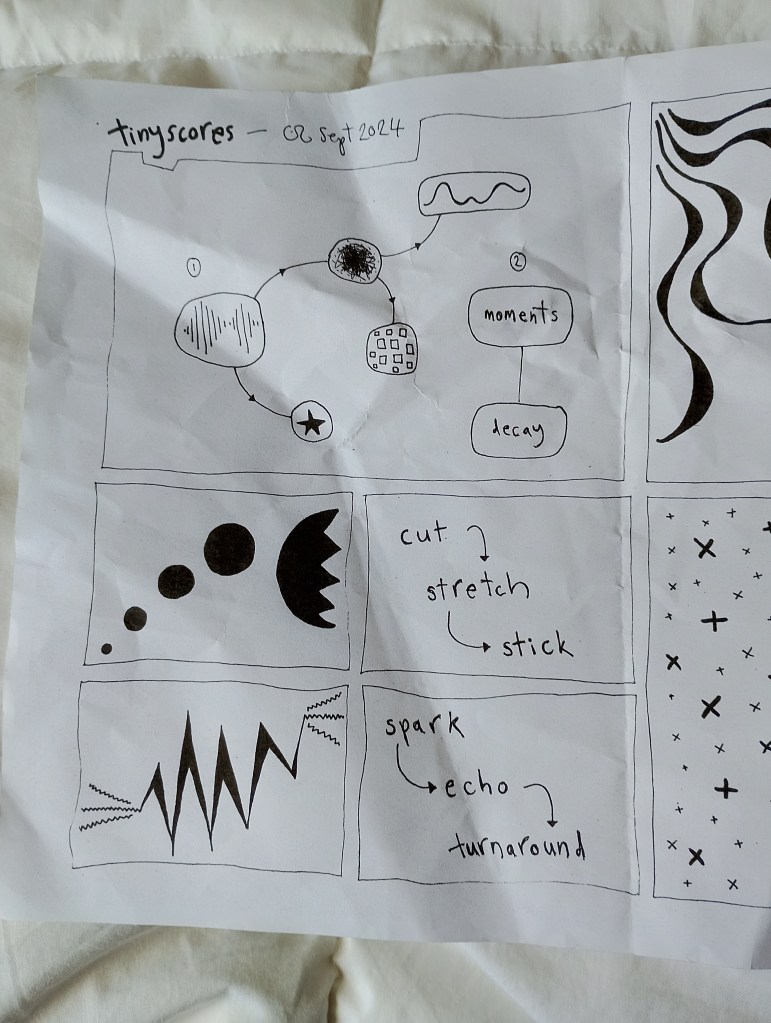
Tiny scores by Cath Roberts.
29 March 2025: ONe_Orchestra New Improvisation Lab
March’s ONe_Orchestra New improvisation lab! There were a LOT of singers present… plus piano, alto sax, OM-wand (see photo), all using voice as well… and movement.
We were wondering whether the 1960s/ 70s pioneers of free improvisation were consciously trying to celebrate the many types and aspects of music that were/are excluded from commercial consideration because NOT recordable: extreme dynamics (especially very quiet sounds); movement and separate locations of sound-sources; the shifting acoustics of a shared space. All the tiny details that no microphone could capture… this was somehow especially relevant to voices, because the human voice is generally quieter (in its natural range) than most instruments. So we used our voices a lot, and they set the level for the other instruments. We were conscious of instrumentalists avoiding getting louder merely because the voices might have got louder… And we moved around the space to feel and listen to how that sounded. Very beautiful, unrecorded.

3 February 2025: ONe_Orchestra New improvisation lab.
Ideas from Sofia Vaisman Maturana, drawing on Audre Lorde, Uses of the Erotic.
As people who are not cis men, could we spend time simply centring and discovering what, in our improvisation and music-making, gives US pleasure? We spend an hour improvising with this in mind, then we discuss how it felt (right!).
The many facets of what we uncover. This is acoustic music, so we are often finding pleasures in the body and its interface with objects, instruments, the space we’re in. At the level of the individual and their instrument, there are sounds that feel good, physically, to make… some of these are the sounds that we have been taught are “correct”, but many (most) are outside that zone: we use our voices in non-standard ways, sometimes alongside our instruments; we deconstruct (literally and metaphorically) our instruments to bring about different sounds and techniques, new physical relationships with the instrument’s elements. We remain in the very quietest dynamic zone for a LONG time, as though exploring a sub-atomic universe of almost imperceptible vibrations, treating our ears and our instruments to sensations generally considered too small for “public” perception. At the same time there is a feral pleasure in stretching melody and rhythm beyond stability… And also great bliss, at times, in letting go of making sound, instead just listening to and enjoying each others’ discoveries… and trusting that the music breathes through our individual silences.
That led us into the collective pleasures to find in improvising, the extraordinary thrill to be had in building our own music, TOGETHER, surprising ourselves and each other with unities and transgressions, pushing structures farther and farther, seeing how to break and re-make them in ways that stimulate our ears and minds, tickle them. Listening and responding in real time, building trust and also challenging it, experimenting with conflicting sounds, re-positioning each other’s music by changing its contexts.
It was so joyous to experience the trust that we shared – and we weren’t prioritising individual OR collective pleasure… or thinking about how to sound “nice”, “proper” – for each other or for an internalised audience. It became clear that the tensions between individual and collective pleasure can be problematic, but they can also build something bigger than either.
10 January 2025: ONe_Orchestra New improvisation lab.
Kirsty Ferguson Lewis
Kate Gathercole
Charlotte Keeffe
Shima Kobayashi
Caroline Kraabel
Olga Ksendzovska
Barbara Mukoda
Arantxa Ortiz
Emily Shapiro
Sofia Vaisman Maturana
All playing essentially acoustically (one small cracklebox was present).
Difference, transgression, challenging and extending standards around what is “good” or “right” in music, instruments and sounds. Inverting hierarchies.
In our lives we know only too well that constraints can lead to new solutions; we are constantly finding ways around the many barriers and threats imposed on us… In music, improvisation around constraints leads to empowering and thrilling new discoveries!
First we improvised really really quietly. Close together, not performative, but for each other. Some instruments (charango, voices) were able to come into their own perfectly at those peaceful, domestic levels, not struggling to to be louder (or quieter). For some, such as piano and sax, it was much more difficult – those instruments are built for “performance” (even domestically, as often with pianos – though this was a grand piano such as few homes have ever had) and/or for playing audibly outdoors, often in a military or state context. They had to adapt/ be adapted! Most of us also used our voices at some point – not a cop-out from difficulties of playing instrumentally at that dynamic, but an extension of what felt right in the situation (“it feels right to me” – Audre Lorde).
Inverting power relationships just by insisting on quiet. Challenging our ears and technique to STAY quiet. Remembering that just because you CAN play loudly doesn’t mean that each time you improvise you MUST remain within any specific dynamic parameters. Discovery of new and different sounds and techniques. How quiet IS quiet? So much is a matter of habits and context. The sounds from neighbouring rooms, roads, the river, became part of what we were doing.
Intermittent frustration; this is important in improvising too: it’s a necessary and uniquely useful way of addressing challenges and the unknown or unexpected.
We continued the theme of the day by improvising very quietly again, but this time with the additional proviso that each of us should listen ONLY to the other musicians, and NEVER to themselves. The music was hesitant but perhaps more exploratory… and the strategies for avoiding awareness of what one was doing were interesting and varied – including the use of physical movement or gestures to generate sounds and get away from self-attention and “skill”, or from standard techniques, control and expectation… or, Emily Shapiro began to play a small electronic cracklebox, with unpredictable interface of metal strips… a radically different instrument from their usual bass clarinet, also distancing them from the usual actions.
Some found this exercise frustrating, too, but the improvising seemed to flow differently, more freely and freshly.
In a way the next improvisation built on what Emily had been doing. Shima had brought a beautiful home-made rain-maker/ kalimba, that uses actual water instead of small grains… its sound was extremely quiet and so beautiful, unexpected. We had an array of other objects available – beaters, small shakers, the furniture, pieces of plastic and wood, little whistles or flutes… and still our voices… we made a lengthy and very quiet improvisation using these objects instead of instruments… in some ways similar to the lab session Khabat Abas led, but her objects were even farther from being musical instruments than ours! Again the balance between frustration and celebration tipped mostly towards the latter, but kept the spice of struggle.
For our final improvisation we all played together again, this time using Shima’s chromatic harmonica as our loudest sound… with all the rest of us playing freely, but staying more quiet than the harmonica at all times.
ONe_Orchestra New: 6 October 2024, Jazz Rumours, long improvisation 15h30-19h00.
Khabat Abas, cello, electronics, etc.
Julia Brüssels, violin, piano, etc.
Kirsty Ferguson-Lewis, voice, etc.
Caroline Kraabel, alto sax, etc.
Olga Ksendzovska, piano, voice, etc.
Sue Lynch, tenor sax, etc.
Saori Miraku, piano, etc.
Barbara Mukoda, flutes, etc.
There were eight of us playing today in the welcoming surroundings of the community centre run by Finsbury Park Housing co-op, which hosts Jazz Rumours on the first Sunday afternoon of each month. There’s lighting, a stage, a bar/cafe… excellent space!
We have always pushed our improvisation beyond standard line-ups and formats; here we began extending the duration of our improvisations. This affects everything, for listeners and for performers. First we made sure to have drinks and snacks available; the seating was chairs around tables, and comfortable sofas.
There was minimal amplification (one vocal mic; a few tiny speakers used by Khabat; occasional radios). We all brought additional small instruments and percussion; everyone played these at different points – knowing that we had a lot of time made this feel absolutely right, providing new ways of sounding and feeling.
As though we were building a vast airy edifice, adding beams, frames, and buttresses to allow the space to grow and lift off, we supported each other or sprang afresh from each new peak… We were able to balance the sharing of the space and time – generally there were three to five people playing, and the personnel was shifting fluidly but not frenetically. A few solos emerged – if we’d played for longer still, these would probably have been extended. The listeners were extraordinary – often concentrating as they would at a 45-minute gig, and always respectful… they felt like, and were, part of the music; by the end we were all bonded by the common experience – intensified living of what music always is.
For the musicians it was an exceptional privilege to play non-stop for 3.5 hours: the sense of responsibility, the chance to begin to understand the ins and outs of duration, and relax into listening and SENSING the space, each other, all the listeners… We felt ourselves expanding musically in real time from the very beginning (since we knew we had a long stretch ahead) – taking responsibility and risks, trying things, offering space, novel ideas, dangerous suggestions to each other and the listeners… the intensity of the listening seemed even greater than at a “standard” gig. We flowed from one line-up or set of sounds to another, but never stopped altogether. The stakes were high, honesty was required.
After the first hour it felt daunting, but time and music seemed to flow more freely from that point, as we entered a terra incognita and curiosity really took hold. The final half-hour flew past…
It felt that the relationship we established with the listeners was still similar to that at a standard gig (which is often two hours of music), so their concentration was of that deep sort and they were really stretched, though they didn’t break – and even seemed to enjoy it. When we eventually play a longer event, we will have to think about how the non-players’ listening will evolve. Here’s hoping that will happen soon!
Tuesday 1 October 2024
ONe_Orchestra New recorded rehearsal at Goldsmiths Electronic Music Studio.
We played (and recorded) from 11h30-16h00, in preparation for Sunday’s performance at Jazz Rumours in Finsbury Park, which will run from 15h30 to 19h00.
As people arrived they joined in, and individuals were able to drop out and re-enter. Initially we were uncertain, then came a growing awareness of the vast difference it makes to improvise solidly for over four hours – we began pacing ourselves, varying the instrumentation, just listening for long stretches. It was challenging both mentally and physically, and we learned a lot as time passed – to trust each other, and to refuel – literally and figuratively: there will be snacks available at Sunday’s performance!
The passage of time felt different, both expanded and compressed – we felt able to take the time to explore specific dynamics and combinations in depth. The physical space was welcoming and comfortable, which helped a lot.
An improvised performance need not conform to any of the parameters of standard performances – this applies as much to duration and location as it does to sounds and roles.
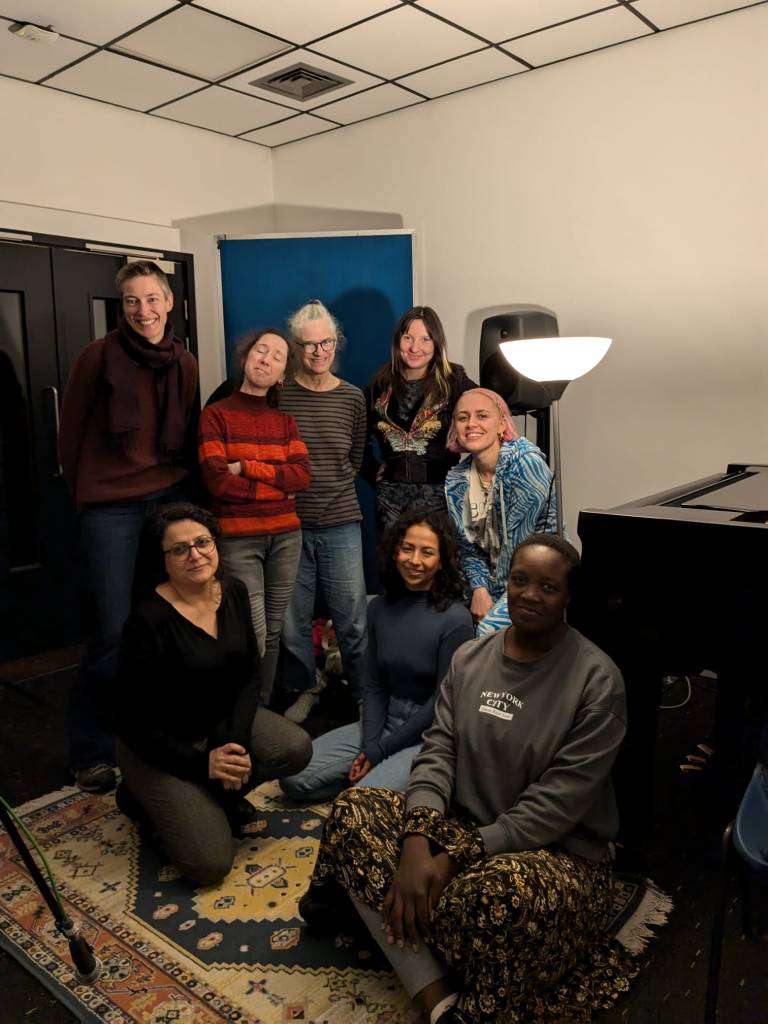
Thanks to Khabat Abas and everyone at Goldsmiths EMS, and to Barbie Mukoda for photos.
19 August 2024, ONe Improvisation Lab.
So many new ideas! Lisa Elde warmed us up with movement; Khabat Abas brought bagsfull of objects, and we detached ourselves from the safety net of instruments to explore what sounds we could (and could not) make with plastic bags, foil, tiny scraps of wood and metal… a long and open-ended conversation involving frustration and inspiration; discovery, embarrassment and new ways of hearing. Our sound-making was sculptural, impoverished and enriched, full of novel movement and devoid of habits or expertise. We challenged our listening, too, because of the individual difficulty of working with objects, and their extreme dynamics; we flowed in and out of communication.
We let go of so much in order to discover… sometimes apparently very little (!), until a change in perspective and engagement seemed to spin us right round into absorbtion. We returned to including our instruments, bodies, and voices in improvisations that were freshly exploratory and open.
16 July 2024
The ONe_Orchestra New performance at The Vortex on 10 July 2024 was transcendent: we surpassed ourself in large group improvisation – and indeed in numbers.
Paula Riofrio, Lu Greco (dances); Anne Yin, Julia Brüssells (violins), Sofia Vaisman Maturana, Khabat Abas, Kirke Gross (cellos); Damsel Elysium (violin, double bass), Shama Rahman (sitar); Lisa Elde, Sharon Gal (voices); Rosa Theodora (Korg!), Olga Ksendzovska (piano), Shima Kobayashi (chromatic harmonica), Barbara Mukoda (flutes), Charlotte Keeffe (trumpet), Dee Byrne, Caroline Kraabel (alto saxes), Sue Lynch (tenor sax), Cath Roberts (baritone sax), Maureen Wolloshin (oboe)… plus Julie Pickard making her beautiful improvised observational drawings of improvised music – 22 people!
The courage, sensitivity, togetherness, readiness to go all out or to hold back… exceptional! Listen out for this space…
16 March 2024
Working towards our next performance, at The Vortex, 11 Gillett Square, London N16 8AZ, on Wednesday 10 July 2024:
Ideas relating to what might make our improvisations different from those of other large improvising groups. Not because we’re women/trans/non-binary, and have some kind of concomitant obligatory fixed characteristics, but because of our experiences in the world:
Definitions and constraints relating to gender (and race, class, sexuality etc.) have been imposed on us (as on all people) externally, in order for those belonging to the ‘top’ categories to extert control and hoard power.
We have all, consciously or not, been hurt by this.
Let us avoid treating each other as we have been treated!
Instead, let us use those experiences of being held back, othered, underestimated, stereotyped, and harmed in so many ways to make us stronger, and better for each other: more generous, confident, understanding, respectful, supportive, wild, brave and free.
In a large improvising group this means, in part, making good use of time and space – equality, awareness, listening, boldness, concertation, concision – and not stereotyping instruments/players into solo/accompanying/underpinning roles.
9 March 2024
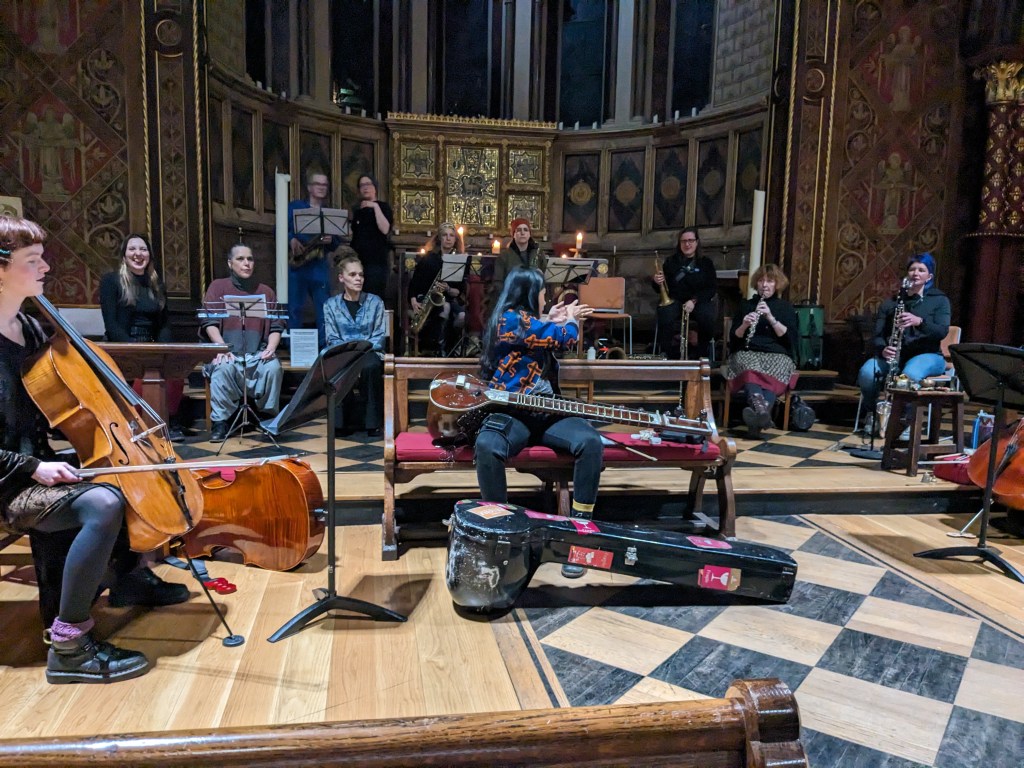
Photo by Barbara Mukoda
“The master’s tools will never dismantle the master’s house.” Audre Lorde
At last night’s performance by ONe_Orchestra New we ended repeating those words in unison, as part of Sofia Vaisman Maturana’s piece Audre Lorde Reminds Us:.
In our world of improvised music they are as true as in the wider world: improvised music’s conventions and expectations are built almost completely around the work of men (as are those of most music for public, commercial, or prestige consumption).
As a result, that music, like so much else in patriarchal societies, is lopsided and lacking, formed mostly by one sort of people (or, indeed, by a few privileged sorts of people), and excluding, omitting, or deforming the other sorts.
Music needs listeners. Listeners need music, art, that reflects ALL the experiences. Jazz, contemporary music, and improvised music were all overwhelmingly male-dominated from their instigation; although this is beginning – very slowly – to change, ideas of what constitutes good music are still almost completely formed in traditions utterly dominated by men – as in every realm, women and “other” genders too often succeed only on condition that they adopt those traditions. Having been raised with and surrounded by these references, it can genuinely be difficult to look and listen beyond them.
This all-pervasive pressure impoverishes art and every domain it touches, as well as constraining artists who are women (or “other”).
ONe_Orchestra New is seeking to forge completely new tools/ideas for free large-group IMPROVISATION – mostly tools not (necessarily) just for women artists, but for anyone who wants to play, listen, see the world in new ways. When we use conducting, devising, scores, etc., we do so with the aim of clarifying or feeling our way towards these new approaches. Some of our early insights:
Equality
Listening, or not listening, in many different ways
Concertation
Intercalation
Strata
Voice
–––––––––––––––––––––––––––––––––––––––––––––––––––––––––––––––––––––––––––
ONe_Orchestra New setlist for 8 March 2024, in the chapel of Kings College London
1. Shama Rahman sitar solo, with orchestra directed by Shama Rahman
2. Improvisation/ Right Here, Right Now (Charlotte Keeffe)
3. Dee Byrne conducting
4. Olga Ksendzovska, Landscapes (Orange Mosquito, Pink Chair)
5. Caroline Kraabel (with Lu Greco conducting middle section by dance), Windows in the Tower of Yearning.
6. Sue Lynch conducting, 1-2-3
7. Improvisation
8. Sofia Vaisman Maturana, Audre Lorde Reminds Us:
––––––––––––––––––––––––––––––––––––––––––––––––––––––––––––––––––––
Personnel
Khabat Abas, cello
Dee Byrne, alto sax
Isidora Edwards, cello
Lisa Elde, voice
Kirsty Ferguson-Lewis, voice
Sharon Gal, voice
Lu Greco, dance
Kirke Gross, cello
Charlotte Keeffe, trumpet
Olga Ksendzovska, piano, trombone
Caroline Kraabel, alto sax
Sue Lynch, tenor sax, clarinet, flute
Shama Rahman, sitar
Cath Roberts, baritone sax
Emily Shapiro, clarinet
Sophia Vaisman Maturana, cello
Maureen Wolloshin, oboe
All use voices.
––––––––––––––––––––––––––––––––––––––––––––––––––––––––––––––––––––––
ONe_Orchestra New: Improvisation Lab, Kings College, 13 November 2023
We started with sustain piece, sticking to one sustained sound per breath, always the same one. Incredible variety of dynamic and texture.
Then we did a piece in which, when one specific person in the group was playing, everyone else was silent, and when they weren’t playing everyone else could play (but silence was also a possibility) – like we’ve done before; for example, with Lu ‘leading’… the intention was that this would evolve with different ‘conductors’, and it did, but in very unexpected ways! A hugely useful exercise in independence and listening! (We carried on with some free improvisations)
We spoke about archetypes, gender, mother/daughter/carer. How one’s value in society can be seen as limited to functions or roles.
We hope to construct new ways of improvising [reflecting the new contributions that people like us can make] out of this trust, exchange and reflection.
We had a lovely improvisation lab on 23 September 2023; some excellent and engaging free improvisations, spacious yet assertive in good ways; using voices as well as instruments. And, a little bit of singing (individually) songs from different traditions… this kind of music offers space and, for us, the potential to acknowledge our own realities and their importance, to be outside industrial/neo-liberal/capitalist modes of music-making, and also reminds us that there is some space in some traditions reserved for (or limited to?) women/ girls/ children making their own music. We also talked about NOT having a traditional-music history or identity, and about issues of class as they relate to traditions… and looking ahead, we could think about what we might get from using some elements, approaches, or moods from these and other traditions, freely, to create forms of improvised communication between ourselves that really match who WE are, today, in an inclusive way.
from Shama R: “I’ve always like this English folk song – and it has crossovers in melody with Indian music, in my opinion!”
Kirsty F-L sang this traditional English song:
The French traditional song Caroline K sang:
The Estonian children’s song Kirke K sang, about a sleepy bear:
Bonus: an Italian song (C19) about the necessity of migration
ONe_Orchestra New assembled in August 2023 to improvise some more. We reflected on the uses of voice at the recent Cafe Oto gig; for example, in Damsel E’s beautiful piece, ‘It’s OK to Grieve for Her’, for Ana Mendieta – crying, laughter, shouting, singing… and when all of us were singing (wordlessly) along with Shama R’s sitar improvisation… and… speech in free improvisation (!), completely different from music in how it carries meaning (we can’t all speak at once and be understood, words are more specific yet less directly emotive, rules are much more strict, etc.). There seems to be a consensus that using words (Sofia V M reading mixed up fragments from her/their/his journals in this case) is also useful in our improvisations, and other people expressed an interest in contributing words.
It can be magical when words enter into music to make song, but how does using one’s voice to make words differ from using it to make music? We do several long improvisations, instrumental then vocal. Quite exposing, very deep.
ONe_Orchestra New, 8PM, 6 July 2023, Cafe Oto London
Preparation:
What are the things that are distinctive about us as performers, and specific to the identitities of the people in ONe? How can we be, and express, ourselves as fully as possible when we improvise? The first thing that springs to mind is our literal VOICES, unique to who we are…
ONe_Orchestra New, 8PM, 14 April 2023, Vortex, Gillett Square, London
Preparation:
Starting points
Distinctions between people are too often used to justify unequal treatment. The source and foundation of our music is that our equality springs from our shared humanity. We’re all different, but we’re all human beings and therefore of equal worth.
We can say that all instruments, all musical educations/cultures, and all sounds are different, and fundamentally of equal worth. Our improvising together is what transmutes our histories and sounds into music.
We can say that the trumpet, violin, or saxophone is not automatically the prominent front-line instrument; the drum is not automatically the instrument that produces rhythms for the group, or the piano the one that provides harmonies. We have all learned roles and rules that apply to types of instruments or people, but we don’t have to stick to those roles.
We can start trying to shape the evolution of the music differently, at times escaping from conventional trajectories such as the gradual crescendo, or volume associated with intensity….
Dynamics: be aware of the different dynamic range of each instrument/player.
Space: allow space for each and all.
Sounds: seek out and nurture sounds that are small, unexpected, “ugly”, misplaced, forbidden … the sounds that are “wrong”.
Performing: seek different ways to be in and share spaces and sounds.
October 2022: At Finch Café we opened with musicians in separate groups, in different parts of the space. Members of each small group improvised with each other, quietly, conversationally. This was our first performance with dancer Lu Greco, who led a piece: when they moved we were silent, when they were still we played.
Why do we make, why seek, unfamiliar sounds or noises? To destabilise, heighten, explore and enlarge… jump the tracks, court disaster!
June 2022: We tried all playing together, but as little as possible (surprisingly effective for building a sparse collective sound, and for keeping a flow going for quite a while). Then we did some conversational improvising, where we all played (nine people) but each listened and responded to one other person at a time. We also revisited creating a collective sound that is very sparse, by playing widely-spaced short sounds, quite distinctly/loudly, and all TOGETHER…
April 2022
Music that was lost, damaged or never made/heard.
As a group made up of people who have experienced forms of oppression in music making and/or life, what is our aim when we make music among ourselves? Do we just recapitulate existing power structures, but try to place ourselves at the top? How deeply ingrained in us are these musical approaches?
Should we consciously aim to avoid those oppressor-created structures and hierarchies (how?) and make new ones?
Can we choose to let go of power (loudness, “skill”, profuseness, traditional roles of instruments) without feeling constrained?
Can we be true to who we are, and to the instruments we play, without drowning out other musicians and their instruments?
Improvising: a way of accessing music in ourselves that is not part of an external system? But this doesn’t happen by itself, requires searching…
How can we play together as a large group and ALL be heard…. how can we respect each other, and be respected?
What is it like to play from silence? From sound?
Getting away from neo-liberal constraints on the concepts around music and musicians: Should we draw on art that is related to what is called the “domestic” sphere (references – pottery, needlework, work-songs, “folk” or traditional musics)? Escape from the idea of what is required of the “professional” musician? How? Is the notion of “ritual” relevant, or is it oppressive?
How do we unite in playing, and how do we play together and maintain our separate identities? The tension between leaving space and filling space…
SPACE, COURAGE, LISTENING and CONCISENESS are essential to large-group improvisation…
How do we make the most of our difference… in how we pay attention, in our ways of listening and uttering? How far can we go into difference?
What is it like to do the “wrong” thing?
 oneorchestranew.com